> For the complete documentation index, see [llms.txt](https://docs.wrangle.io/llms.txt). Markdown versions of documentation pages are available by appending `.md` to page URLs; this page is available as [Markdown](https://docs.wrangle.io/workflows/designing-a-workflow/approvals.md).
# Approvals
## How Approvals Work
Wrangle's approval functionality lets reviewers consider a request and explicitly approve it, reject it, or request changes.
An approval thread posted to Slack
## When Approvals Are Considered "Approved"
When an approval is created, one or more people might be assigned to review the request. Wrangle gives you several options for deciding when enough people have signed off on the request to consider it fully approved:
* **Any one approver**. With this option, you can assign approvals to multiple people, but only one of those people needs to approve it. This is useful for letting whoever is available to review to request to jump on it and resolve it.
* **All approvers**. With this option, you assign the approval to a group of users and you need *all* of them to click the "Approve" button before the overall approval is considered done.
* **A majority of approvers**. Similar to the option for all approvers, this one is often more realistic — get more than half the reviewers to approve. The majority option is useful when vacations or other unavailability can prevent one or two people from approving and thus not meetings the "All approvers" threshold.
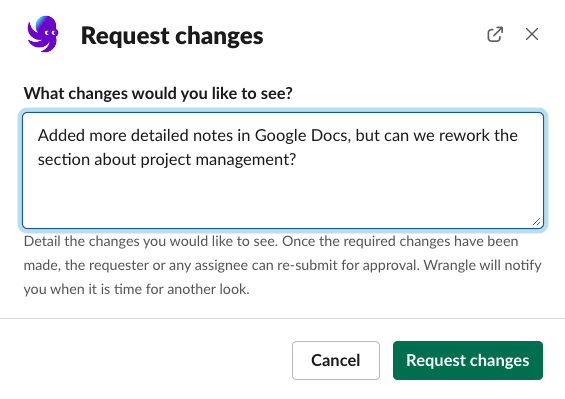
Approvals also include the option for reviewers to request changes. Approvers can click "Request Changes" on the approval step to add their notes on what needs to be changed.
Approvers can add context about what changes need to be made
After an approver requests changes, the thread will update with their notes, and either the requester or an assignee from a previous step can resubmit for approval.
The approval step in Slack after an approver requests changes
## Launching One-Off Approvals
Most approvals are launched via a [Wrangle workflow](broken://pages/-Mj5blROPstTOn9CIYfZ) for a recurring use case. But you can also start a one-off approval for work that comes up from time-to-time. For example, if you're working on a document (outside of a Workflow) that you want your boss to review, you could create a one-off approval for that.
You can launch a one-off approval in one of many ways:
* There's a button on the [Wrangle App Home page](/best-practices/wrangle-app-home.md)
* You can use Slack's search bar and look for "Start an Approval with Wrangle"
* You can use the Shortcuts menu by clicking the ➕ icon in the reply box and searching for "Start an Approval with Wrangle." Instead of clicking the icon, you can also type "/" in the reply box as well.
## Editing Approvals In Progress
If an approval has not been completed, you can edit who is assigned to it. You can't remove people who have already approved, but can can make two kinds of edits:
* You can remove people who have not yet approved
* You can add in new people to be reviewers
{% hint style="info" %}
Not everyone can edit an in-progress approval.
If the approval was created by a [workflow](broken://pages/-Mj5blROPstTOn9CIYfZ), it can only be edited by people assigned to the approval or by the workflow's admins.
If the approval is a [one-off approval](/workflows/designing-a-workflow/approvals.md#launching-one-off-approvals), it can only be edited by people assigned to it, or to its creator.
{% endhint %}
## Assigning an Approval to an Out-of-Channel assignee
When an approval request is assigned to someone who isn't a member of the workflow's Slack channel (such as for a private channel), Wrangle detects this and sends that person a direct message with the step instead of posting it in the channel.
Subsequent updates to that step thread continue in the same DM.