# Instance View

From the Workflow Dashboard, you can click on any workflow instance name to open the instance view. \
\
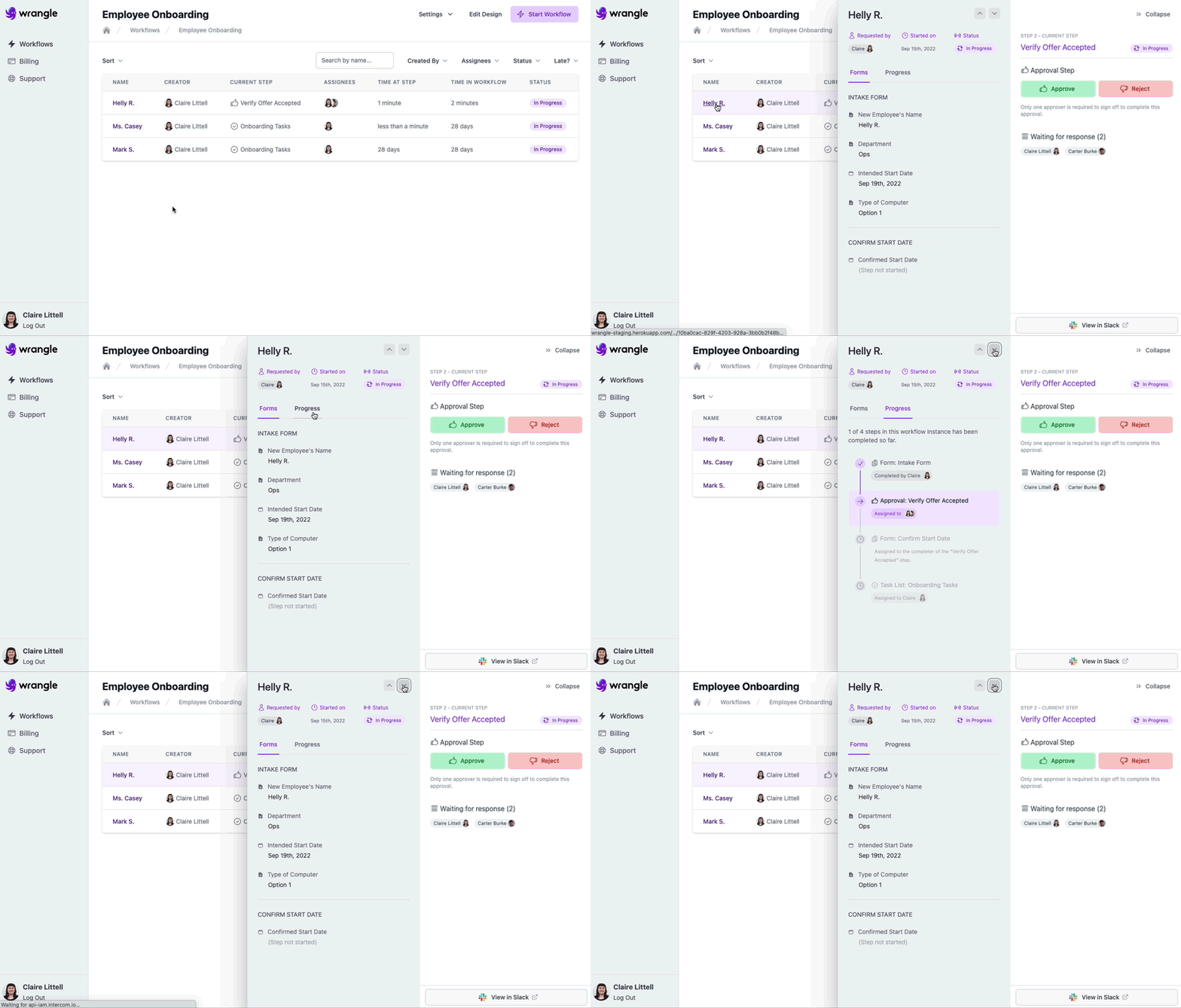
Use the instance view to:&#x20;

* Review form responses
* Easily complete approvals, tasks, and forms, or jump into Slack to comment in the thread
* See timestamps for who approved the workflow or completed tasks
* View what steps still remain and see why an instance is bottlenecked
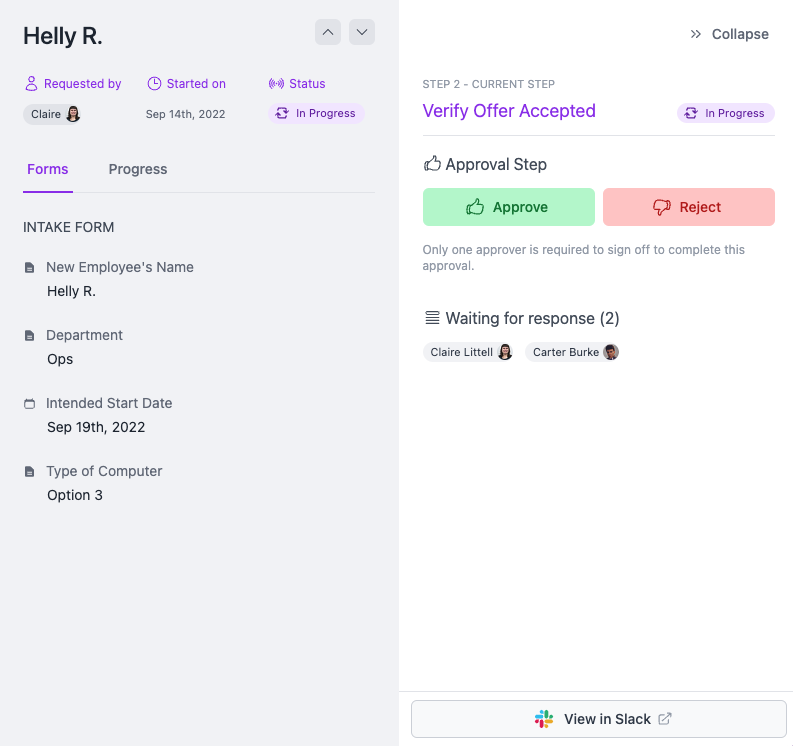
* Quickly toggle between instances to see where they all stand using the :arrow\_up\_small: and :arrow\_down\_small: icons

<figure><img src="/files/kRmincbC56XbGTSKeVNq" alt=""><figcaption><p>Review multiple instances to see their progress.</p></figcaption></figure>

### Using the instance view

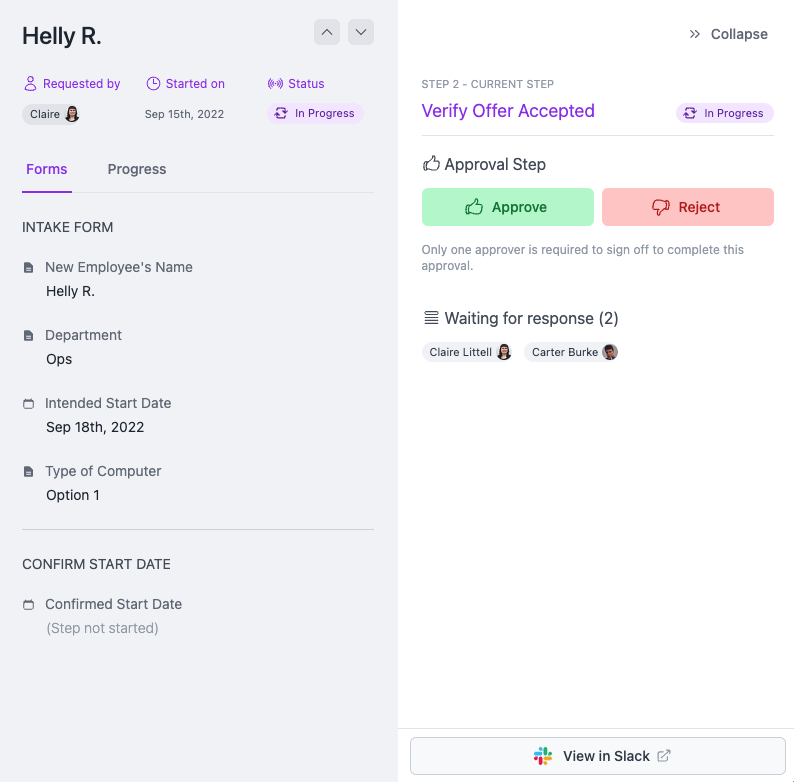
When you open up an instance, you'll see the requester, start date, status, and form responses on the left. On the right you'll see more details about the current step, including the ability for assignees to take action and a link to view the thread in Slack.

<figure><img src="/files/hYlYHmZMzoL4XPaQQUjV" alt=""><figcaption><p>By default, the intake form responses are displayed on the left.</p></figcaption></figure>

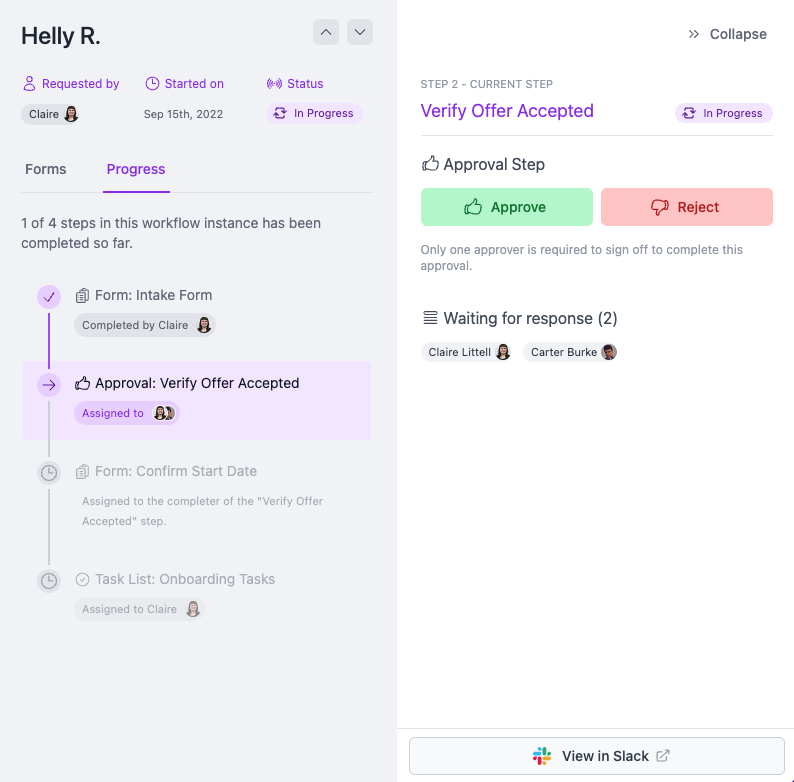
Use the "Progress" tab on the left to view a timeline of every step in your workflow and to see more details about each one.&#x20;

<figure><img src="/files/s979Owz6lBtSt7kfcneV" alt=""><figcaption><p>Switch to the "Progress" tab to see all completed and upcoming steps in the workflow.</p></figcaption></figure>

This is what an approval step looks like:&#x20;

<figure><img src="/files/FQhfNI8tk9dkllCTl0Wg" alt=""><figcaption><p>See who was assigned to the approval and how may approvers are needed in order to advance the workflow. If it's been completed, you'll also see a time stamp.</p></figcaption></figure>

This is what a form step looks like:

<figure><img src="/files/NdVE4QhDHHvmkbp8GnxB" alt=""><figcaption><p>See the questions in your form step and who it's assigned to. If it's been completed, you'll also see both the responses and a time stamp.</p></figcaption></figure>

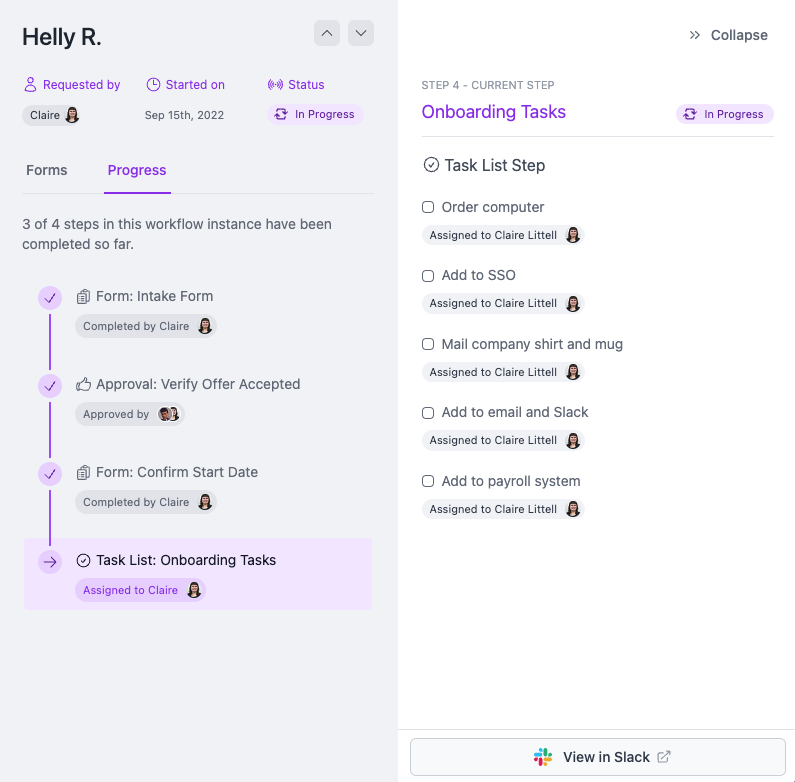
And this is what a task list step looks like:&#x20;

<figure><img src="/files/F1LZqqMrLO0ccdSlBHzb" alt=""><figcaption><p>See who's assigned to each task and what the status of each task is. If all tasks have been completed, you'll also see a time stamp.</p></figcaption></figure>

### Taking action

Assignees can take action directly from the instance view, either by completing approvals, checking off tasks, or filling out forms. The instance thread in Slack will update in real-time as work is completed.&#x20;

<figure><img src="/files/hbj8F8CwDMapy3ROl6ZI" alt=""><figcaption><p>Take action directly from the instance view.</p></figcaption></figure>

### Sharing an instance

Each instance has a unique URL, so if you ever need to share an instance for someone else to review or take action on, you can send them a direct link to it. [User permissions](/workflows/designing-a-workflow/editing-workflow-settings-and-design.md#users-and-permissions) still apply; users must be either an admin or observer for the workflow overall, or the requester or assignee for that specific instance in order to be able to view it on the web.&#x20;


---

# Agent Instructions: Querying This Documentation

If you need additional information that is not directly available in this page, you can query the documentation dynamically by asking a question.

Perform an HTTP GET request on the current page URL with the `ask` query parameter:

```
GET https://docs.wrangle.io/workflows/monitoring-and-managing-a-workflow/instance-view.md?ask=<question>
```

The question should be specific, self-contained, and written in natural language.
The response will contain a direct answer to the question and relevant excerpts and sources from the documentation.

Use this mechanism when the answer is not explicitly present in the current page, you need clarification or additional context, or you want to retrieve related documentation sections.