# Forms

## Default Form Fields

Wrangle has a default ticket creation form for your end users that includes several form fields:

* Ticket Name -  a general label for the ticket.
* Ticket Description - an optional field that can be used to gather more information.
* Priority - hidden from requesters by default but you can choose to show this to allow requesters to set priority when creating a ticket.

Within Slack, your users will be asked to select an inbox, and then will be provided with the ticket name and description field when creating a new ticket:

<figure><img src="/files/n6rlHKctEAg6krIsFa3H" alt=""><figcaption></figcaption></figure>

When configuring your inbox, you have the option to customize the Ticket Name and Ticket Description fields to fit your own use cases. For example, you might want to add a custom label and placeholder text value for the Ticket Name field, and then hide the Ticket Description field from your end users:<br>

<figure><img src="/files/3SIRUuLZo0zNnKLGogGC" alt="" width="280"><figcaption><p>Modifying default form fields for your inbox</p></figcaption></figure>

This would result in a simplified ticket creation form:

<figure><img src="/files/HSSQMVPXh25oV2s900Lr" alt=""><figcaption></figcaption></figure>

## Custom Form Fields

<figure><img src="/files/YHLjb5fK5u8x51OY1WtB" alt=""><figcaption></figcaption></figure>

Custom form fields are a powerful way to collect additional information from your end users when a ticket is created. This can save a lot of time for your agents, avoiding the need for them to go back and forth collecting pieces of information you may already know will be necessary.\
\
Wrangle supports a wide variety of form field data types so you can collect different kinds of information based on the specifics of your inbox.

* **Short Answer** - text input for one or two line responses
* **Long Answer** - expandable long form text input for gathering extra context
* **Number Input -** allows only numbers, which can be useful if you want an extra layer of input validation before your agents are assigned to tickets
* **Select from List** - allows for single and multiple selections, and can be customized to allow users to do things like "**Select a product line"**, or "**Select your operating system**" to help your agents more effectively triage and process tickets
* **Select a Person/People** - includes a searchable list of users in your Slack workspace, and can be used to reference a department head, manager, or relevant colleague(s) to more effectively process the ticket
* **Select a Channel** - a searchable list of channels in your Slack workspace
* **Select a Date** - can be used to allows ticket requesters to specify when they need or expect a resolution, or to indicate related dates that will be relevant for agents resolving your tickets&#x20;

Here's an example of how you can add a custom form field with a description that includes a link to help your end users complete the form:<br>

<figure><img src="/files/n5vWNworYqWWv3kdtmQr" alt=""><figcaption></figcaption></figure>

{% hint style="success" %}
You can also **add a description** to the form field to give the requester more information and context when filling out the form. This can include external help links, why this question is important, and how to answer the question correctly. Use Slack markdown for formatting.
{% endhint %}

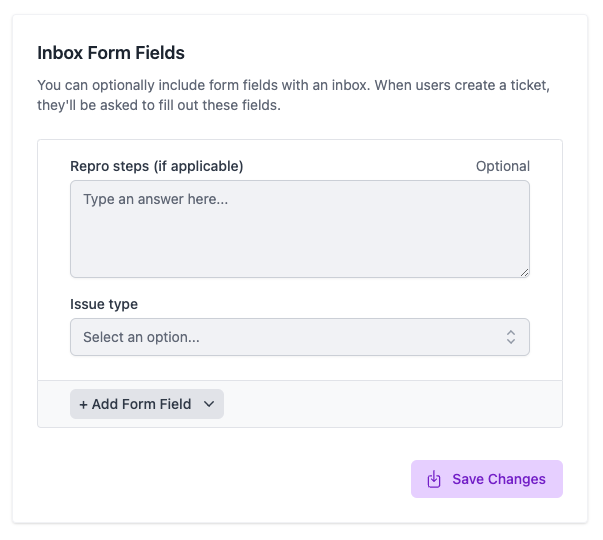
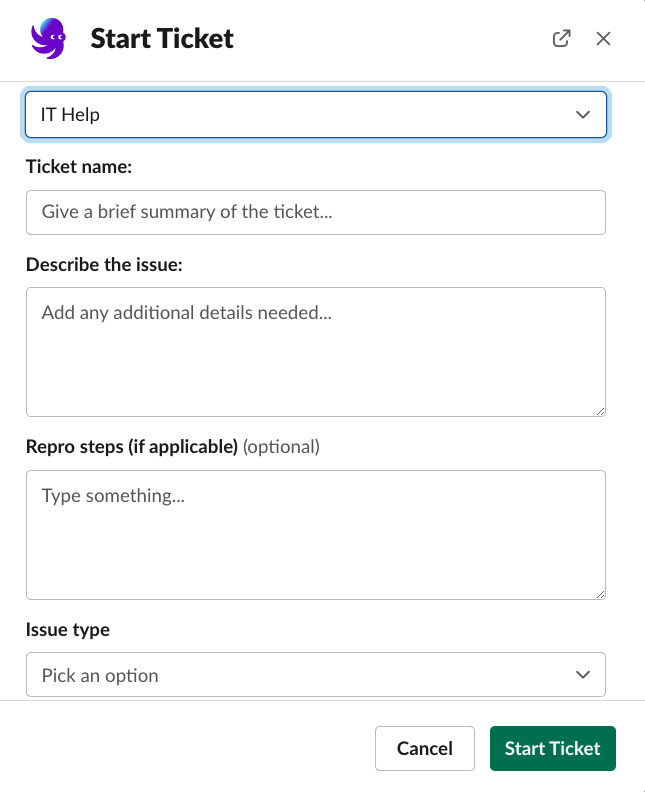
<div><figure><img src="/files/bImKWv4r6KYKDu4pzUhJ" alt=""><figcaption><p>Example form fields for an IT Help inbox</p></figcaption></figure> <figure><img src="/files/ChwJO2qVJRlI1pNXOwH7" alt=""><figcaption><p>Your requesters will see both the default fields and your additional form fields when submitting a ticket.</p></figcaption></figure></div>

#### Rearranging Form Field Order

You can reorder your form field questions by clicking and dragging them in your desired location.&#x20;

<figure><img src="/files/Xa07piAPvKQj5oiy0x8u" alt=""><figcaption><p>Reordering form fields</p></figcaption></figure>

{% hint style="info" %}
Note: if you want to include formatting with links in your form field descriptions, Wrangle supports [Slack Markdown](https://www.wrangle.io/post/slack-markdown-a-comprehensive-guide-to-formatting-messages) in these fields.
{% endhint %}

\
Now your end users will see a new required field called "What is your Employee ID?"

<figure><img src="/files/vo1UzfRGZgb6U2C1h7H2" alt=""><figcaption></figcaption></figure>

***

## Dynamic Form Fields (Conditional Logic)

Dynamic form fields allow you to create smarter, more responsive ticket forms by displaying or hiding fields based on previous answers. This ensures that your end users only see the fields relevant to their request, reducing clutter and improving efficiency.

<figure><img src="/files/0efqbZS2Lx59SxPQveyF" alt=""><figcaption><p>Live dynamic form "Hardware Type" appears only when "Hardware" is selected</p></figcaption></figure>

### How It Works

With **Conditional Form Fields** you can configure custom form fields to appear dynamically based on a user's input. For example:

* If **"Request Type"** is **"Hardware"**, then a field for **"Hardware Type"** appears.
* If **"Do you need manager approval?"** is **"Yes"**, then a field for **"Manager's Name"** appears.

This functionality allows you to collect the right information at the right time, streamlining the ticket creation process.

### Setting Up Conditional Form Fields

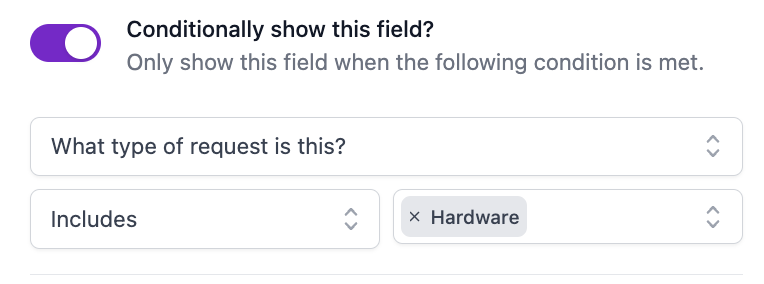
<figure><img src="/files/QpXH6mxB7ngb497RdtOP" alt=""><figcaption><p>Making a form field conditional</p></figcaption></figure>

When configuring your inbox, you can add dynamic behavior to your ticket form:

1. **Go to Your Inbox Settings**
   * Navigate to **Form Fields** and select the form you want to modify.
2. **Enable A Form Field for Conditional Logic**
   * Select the field that should appear conditionally.
   * Toggle on **"Conditionally show this field?"**
3. **Define the Conditions**

   * Define the following conditions that need to be met in order for requesters to see this form field:&#x20;
     * Which previous question would you like to make this form field conditional on?&#x20;
     * What data response criteria need to be met in that previous question in order to show this form field?&#x20;
     * This could be: Includes, Does not Include, Equals, Does Not Equal, Greater Than, Less Than, Equal To, etc.&#x20;

   <figure><img src="/files/GE3cqRWK1EOSkEu7aJGh" alt=""><figcaption></figcaption></figure>

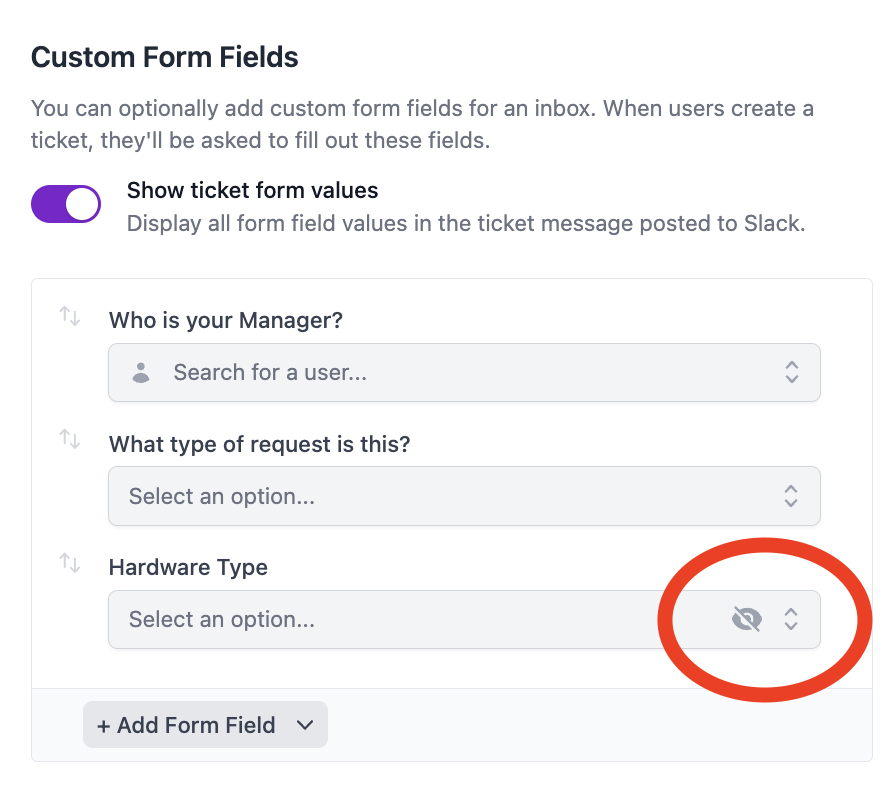
You can see which form fields are conditional by Crossed Out Eye icon on the right side of each form field. This indicates that Conditional Logic is turned ON for this form field.&#x20;

<figure><img src="/files/IgO4crCODxpuPXOTrMdp" alt=""><figcaption><p>This icon indicates that conditional logic is activated for this form field. </p></figcaption></figure>

{% hint style="info" %}
Note: only **Required** form fields can be used as a conditional for conditional form fields.
{% endhint %}

#### Benefits of Dynamic Forms

✅ **Simplifies Forms** – Users only see necessary fields, reducing form fatigue.\
✅ **Improves Data Accuracy** – Ensures users provide required details only when relevant.\
✅ **Enhances User Experience** – A cleaner, more intuitive ticket submission process.

With dynamic form fields, your Wrangle inbox can better adapt to different request types, helping your team process tickets more efficiently.


---

# Agent Instructions: Querying This Documentation

If you need additional information that is not directly available in this page, you can query the documentation dynamically by asking a question.

Perform an HTTP GET request on the current page URL with the `ask` query parameter:

```
GET https://docs.wrangle.io/tickets/setting-up-your-inbox/forms.md?ask=<question>
```

The question should be specific, self-contained, and written in natural language.
The response will contain a direct answer to the question and relevant excerpts and sources from the documentation.

Use this mechanism when the answer is not explicitly present in the current page, you need clarification or additional context, or you want to retrieve related documentation sections.